
Enterprise Content and AI Development
Future Of AI Enterprise Content
Enterprise Content and AI Development
The development of enterprise AI has shifted away from massive, general-purpose language models toward specialized, domain-specific AI systems. These specialized systems give organizations greater control over their data while optimizing performance for specific business use cases. Furthermore, the rise of agentic AI represents a significant trend where systems can execute complex workflows, make decisions, and take initiative with minimal human intervention.
However, the success of these advanced models relies entirely on the quality of the data feeding them. High data quality is crucial for AI and AI agents to prevent biased predictions, faulty recommendations, and hallucinations.
-
As organizations scale their AI initiatives from exploratory pilots to production environments, the tolerance for imperfect data vanishes.
-
Data quality management is recognized as a top priority because accurate decisions demand reliable and consistent data.
-
Trustworthy and well-governed data acts as the necessary foundation for all ongoing technological innovation.
-
Inconsistent data quickly undermines user trust, adoption rates, and the overall business case for AI implementations.
The Benefits of High-Quality Enterprise Content
Enterprise AI models frequently fail or hallucinate not because the algorithms are weak, but because they are asked to answer domain-specific questions without access to the necessary internal information. Large language models are trained on massive datasets, but lack inherent knowledge of a specific company’s proprietary technical documentation, customer records, or internal policies.
Providing AI models with high-quality, curated enterprise content offers several distinct benefits:
-
Models can base their answers on actual company data rather than guessing or generating plausible-sounding but fake responses.
-
High data quality standards increase flexibility for business users and strengthen their overall trust in the data platform.
-
Autonomous systems and agentic AI require clean, well-structured metadata to interpret context correctly and deliver reliable recommendations.
-
Proper data curation directly improves model accuracy by reducing bias and accelerating the training process.
Existing Content Collection and Curation Methods
To feed AI systems effectively, businesses employ strategic data curation, which involves collecting, organizing, validating, and maintaining datasets to ensure they deliver reliable results. This is an ongoing discipline that addresses technical formatting, semantic consistency, and long-term dataset integrity.
Modern data curation heavily leverages AI data cleaning, a process that uses machine learning to automatically detect, correct, and standardize errors across large datasets.
| Curation Method | Description |
| Machine Learning Pattern Detection | Algorithms learn patterns from historical corrections to continuously improve data quality over time. |
| Automated Deduplication | Uses probabilistic matching and fuzzy logic to identify if two records represent the same entity, even when details differ. |
| Continuous Monitoring | Regular validation and updates maintain dataset relevance as real-world conditions evolve and prevent data drift. |
| Hybrid Workflows | Combines automated tools to handle large scales with human expertise to ensure contextual accuracy and fairness. |
Cleaning and Controlling Web Misinformation
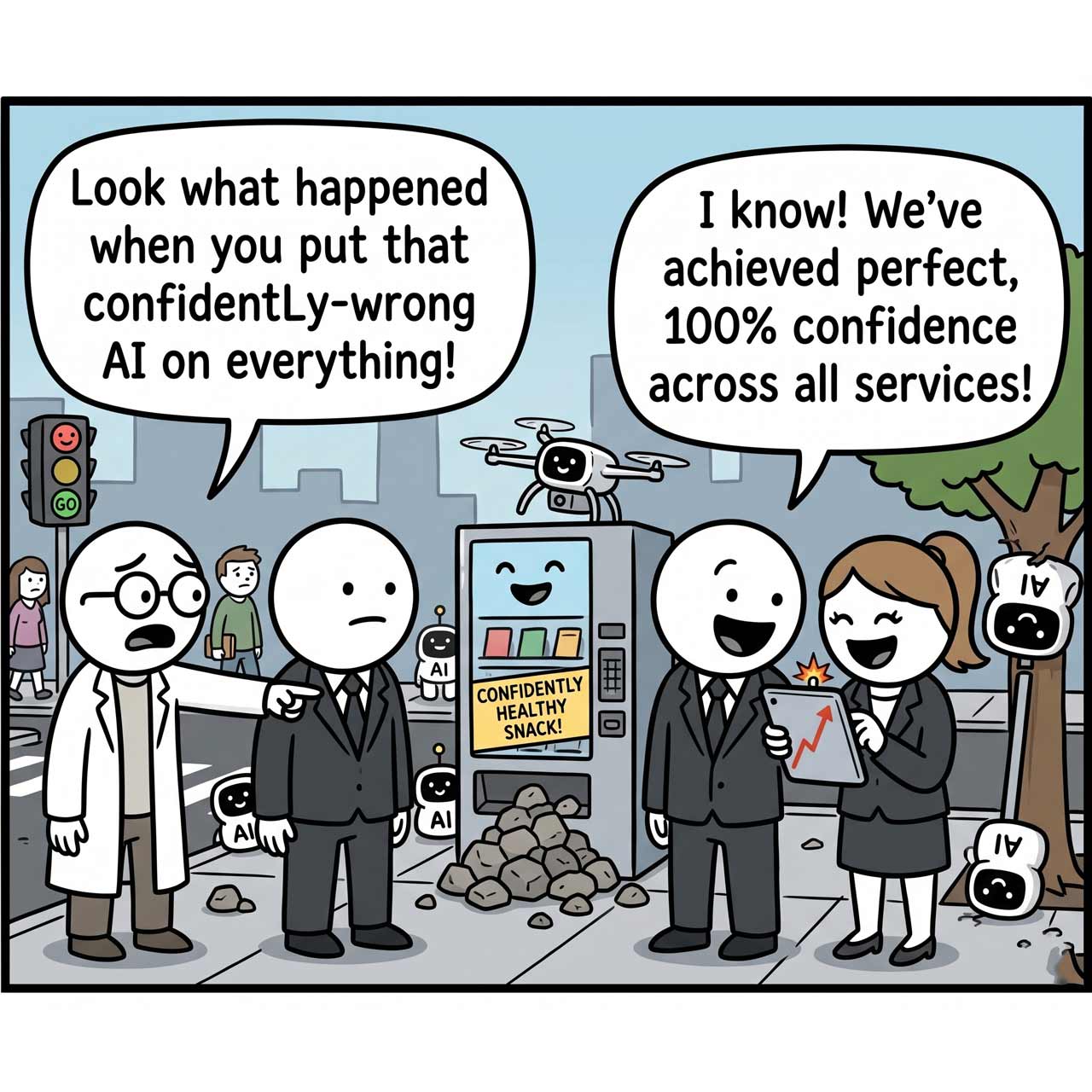
The core joke of the provided cartoons is the AI’s unwavering confidence in its incorrect outputs—a phenomenon known as AI hallucination. Hallucination occurs when a model generates false or misleading information that appears plausible but is not based on real data or facts. It is often caused by biased training data, limitations in model complexity, or ambiguous prompts.
Important Note: While advanced architectures significantly suppress hallucinations, they cannot eliminate them entirely if the referenced source documents themselves are flawed, biased, or contradictory.
To prevent AI from inventing product specifications, misattributing contract clauses, or providing outdated company policies, enterprises must implement strict control mechanisms:
-
Retrieval-Augmented Generation (RAG): This technique enhances language models by integrating an external retrieval mechanism, allowing the AI to fetch relevant documents and generate responses based on that real-time context rather than relying solely on pre-trained knowledge.
-
Enhanced Factual Grounding: Utilizing RAG improves factual grounding, reduces hallucination risk, and enables customization with proprietary data.
-
Bounded Knowledge Bases: Workflows should be restricted to a narrowly defined, highly curated data room containing only approved documents, explicitly excluding live web search results or uncurated third-party content.
-
Auditable Retrieval Steps: Information retrieval must be built as a discrete, auditable step where the system logs exactly which chunks of data were pulled before passing them to the generation phase.
-
Constrained Generation Prompts: AI prompts must explicitly instruct the model to answer based ONLY on the provided source documents and to admit ignorance if the answer is not found within them.
-
Verification Gates: Any high-stakes or irreversible action, such as writing to a database or sending an email, requires a verification gate, which can be an automated cross-check or a human-in-the-loop checkpoint.
-
Continuous Feedback Loops: Post-deployment monitoring should collect logs of any hallucination incidents to feed back into the system, improving the model through ongoing refinement.
External Resources
For further reading on how enterprises are tackling these challenges, explore the following resources:
-
IBM: What are AI Hallucinations? – A deep dive into why AI models generate false information and how to mitigate the risks.
-
AWS: What is RAG (Retrieval-Augmented Generation)? – An architectural overview of grounding AI in authoritative enterprise data.
-
McKinsey: The Data Architecture You Need for AI – Strategic insights into structuring corporate data for machine learning adoption.
-
Gartner: How to Build a Data Foundation for AI – Best practices for data quality, governance, and management in an AI-first world.
#ArtificialIntelligence #EnterpriseAI #DataGovernance #AIHallucinations #RAG #MachineLearning #TechHumor #DataQuality #BusinessStrategy #FutureOfWork