
Epistemic Crisis in the Digital Age: Data Pollution and the Vital Imperative of Enterprise Information Management
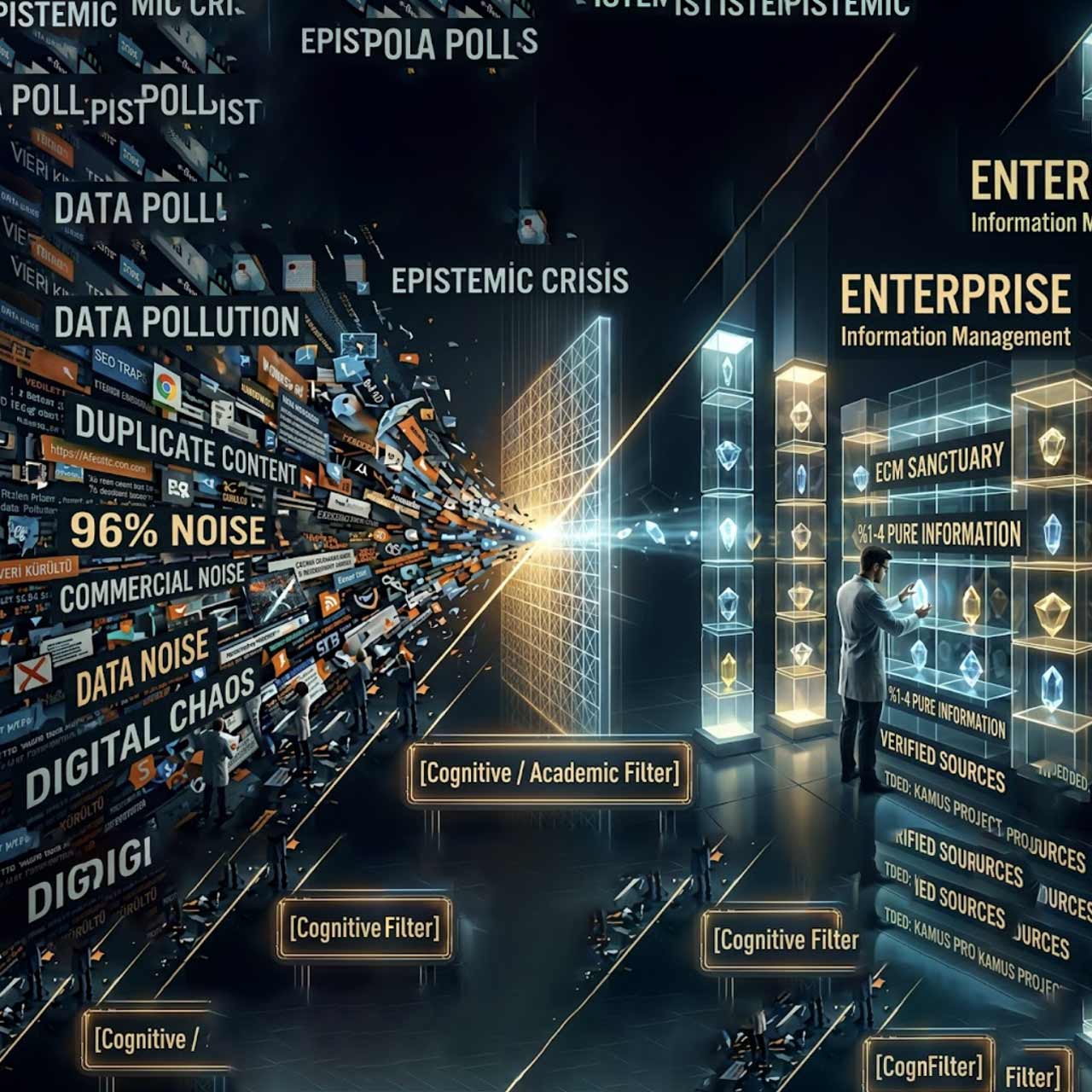
Epistemic Crisis in the Digital Age: Data Pollution and the Vital Imperative of Enterprise Information Management
Abstract
This article examines the production models of global internet networks, identifying the structural prevalence of duplicate content and commercial “noise” through a quantitative lens. When the structural components of the digital ecosystem are filtered, the resulting scarcity of “pure information” reveals an epistemic crisis threatening both academic and corporate sustainability. This study analyzes why Enterprise Content Management (ECM) and verified information architectures are becoming a mandatory standard for ensuring academic reliability and strategic integrity against the structural risks inherent in the open internet.
1. Introduction and the Macro-Structure of the Digital Ecosystem
Modern society often perceives the internet as an infinite, ever-expanding oasis of knowledge. However, macro-level traffic and volume reports suggest a starkly different reality: a digital universe trapped in a spiral of “Data Pollution” and entropy. This environment, characterized more by noise density than information density, disrupts the conversion process of raw data into verified, actionable knowledge or wisdom. The pollution level of open internet networks directly compromises the output quality of higher education institutions and manipulates the strategic decision-making mechanisms of global corporations.
2. Structural Decomposition of the Global Internet Data Pool (Simulation Model)
If we define the total internet data volume as a homogeneous pool of 100 units (U total = 100, data mining indices from international content research institutions reveal a clear elimination and filtration algorithm:
2.1. Data Deduplication
In data engineering, “Deduplication” addresses the largest structural waste in the internet backbone. Due to automated bot scripts, news syndication networks, SEO-driven content farms, and unverified forum citations, at least 50% of the global network is confirmed to be redundant.
2.2. Categorical Noise and Commercial Filtration
When applying traffic distribution indices to the remaining 50 units, three primary noise layers intersect:
-
Pornographic and Entertainment Cluster Pe): Dominates approximately 25% of total bandwidth consumption.
-
Marketing and SEO Activities (Ma): Commercial texts targeting visibility rather than information comprise 20%.
-
Commercial Commodity/Advertising Catalog Data (Tc): E-commerce dynamic pricing and marketplace listings account for 10%.
After filtering these stochastic intersections, the mathematical representation of “Pure Information” (academic literature, peer-reviewed journals, verified historical archives, open-source code libraries, and encyclopedic original texts) is constrained to:
3. Epistemic Threats and the Threshold of AI Poisoning
The fact that 96% of the open internet is obscured by a wall of noise creates two fundamental paradigms:
-
Searching for a Needle in a Haystack: The cognitive load—the time and financial cost required for researchers and institutions to access verified information—is increasing exponentially. Pioneers such as Hans Rosling and the founder of the Web, Tim Berners-Lee, have extensively debated these usage patterns in TED talks, emphasizing the necessity of making internet utilization more effective. As Üzeyir İlbak (TDED – Turkish Language Association) eloquently posited through the “Kamus Project,” the internet acts like a river flowing with debris; extracting the valuable, “pure” information requires expert guidance and specialized filtration.
-
Degeneration of Large Language Models (LLMs): AI systems (e.g., ChatGPT, Claude) are trained on this massive, polluted pool. Incorporating synthetic data and commercial noise without rigorous cleansing leads to “hallucinations” and “model collapse.”
Reference: Stanford Digital Information Reliability
4. The Role of Enterprise Content Management (ECM)
Open networks have made ECM systems and “Enterprise” data architectures a vital sanctuary.
| Open Internet Pool | Enterprise (Corporate) Architecture |
| 50% Duplicate Data | Closed-Loop Data Validation (Silo) |
| 25% Pornography / Entertainment | Peer-Reviewed / Accredited Provenance |
| 30% Commercial / Advertising | 100% Pure, Actionable Info Density |
4.1. Characteristics of Enterprise Data Management
-
Data Isolation (Silo Architecture): Institutions operate secure databases shielded from external noise, accepting only accredited inputs.
-
Provenance and Traceability: Every piece of information is recorded via digital signatures, detailing the methodology and the creator.
-
Ontological Consistency: Definitions are governed by strict institutional taxonomies, immune to the subjective manipulation prevalent on the open web.
The TDED (Turkish Language Association) stands at the global forefront of linguistics and terminology management, possessing the structural capability to provide leadership to major global entities like Oxford and HarperCollins in standardizing information taxonomy.
References for Academic Reliability:
5. Conclusion
While the internet offers a display of power through sheer volume, structural analysis proves that 96% of this volume holds no scientific or intellectual value. The scarcity of high-value information necessitates a shift: both academia and industry must cease their dependency on the polluted flow of the open internet and invest in verified, traceable, and structured enterprise architectures. In the digital future, the most valuable meta-commodity is not information itself, but the “filtered and verified” pure state of that information.
#DataPollution #EpistemicCrisis #EnterpriseContentManagement #DigitalLiteracy #BigData #KnowledgeManagement #AIethics #InformationSecurity #TDED #DigitalTransformation