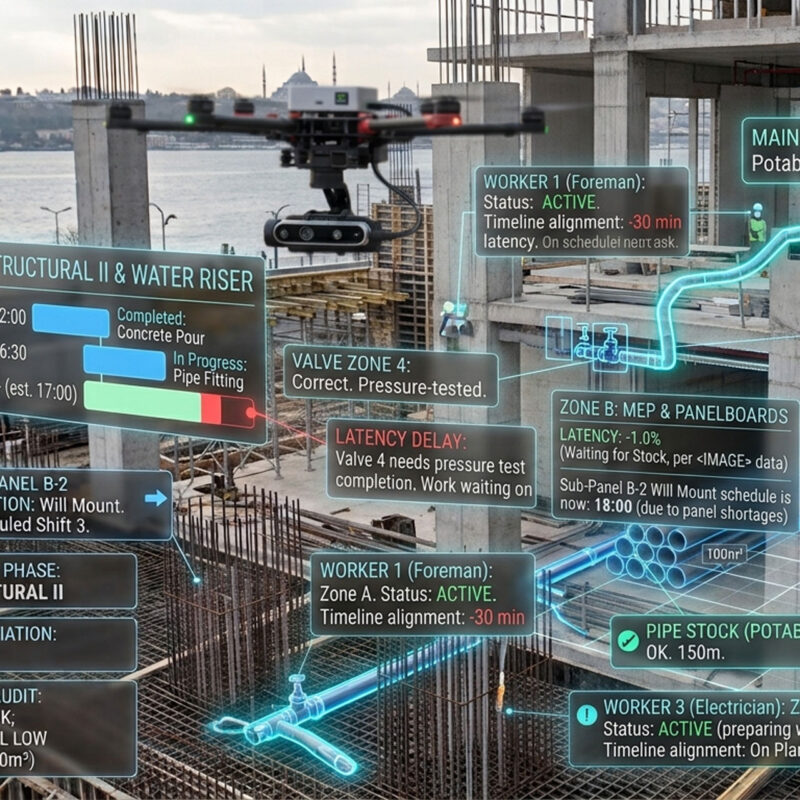
The BIM Form Factor Paradigm: From Sumerian Tablets to Spatial AI and BIM 2.0

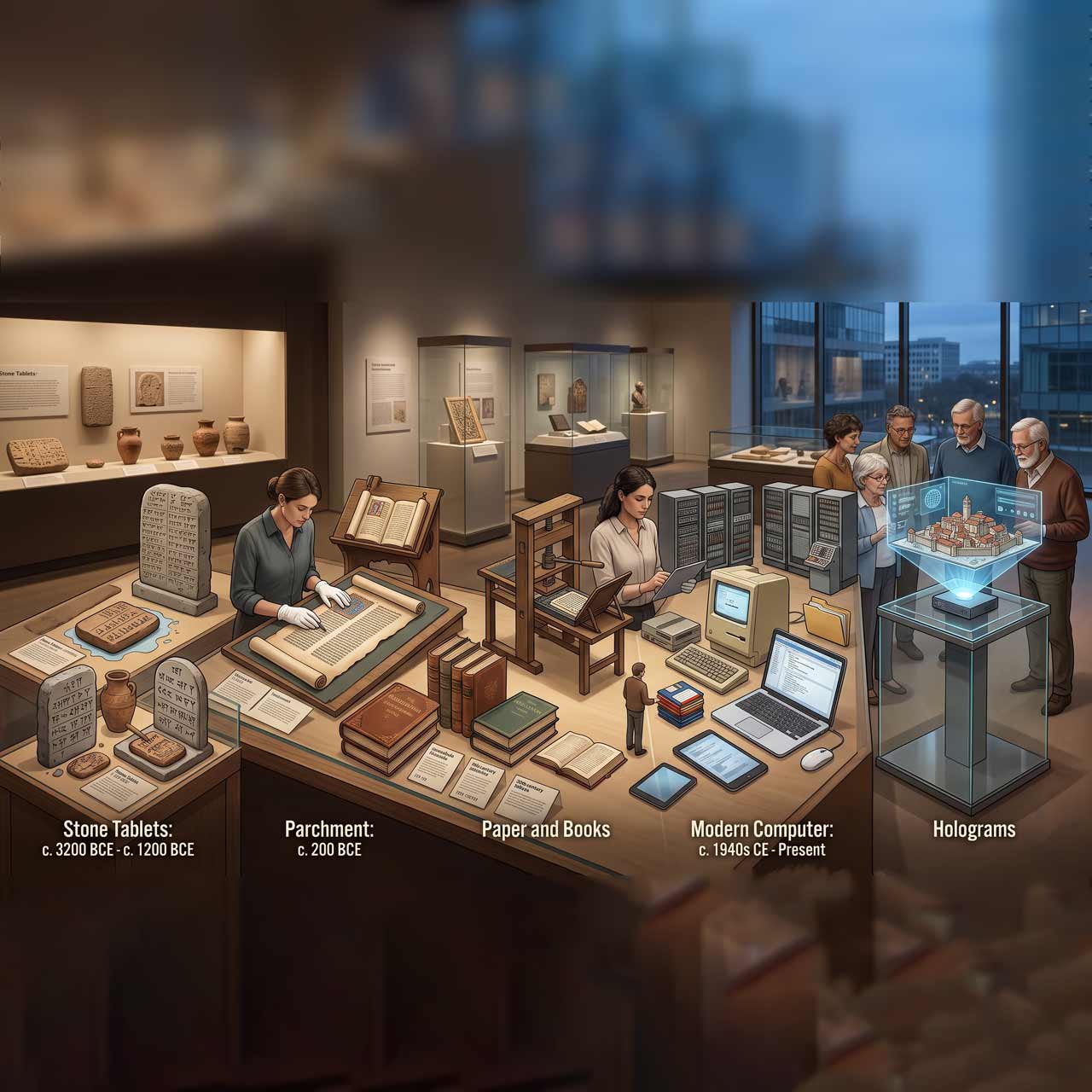
Form Factor 5000 Years Timeline
The Form Factor Paradigm: From Sumerian Tablets to Spatial AI and BIM 2.0
The evolution of human knowledge is not merely a history of ideas; it is a history of the structures that contain them. Yet, a fundamental misconception plagues modern technological discourse: the tendency to disguise technical structural failures as philosophical or behavioral problems. When systems fail or frustrate, the industry often retreats behind a wall of universal virtues, blaming user error or societal habits, rather than addressing the core technical reality.
The problem is not a moral one. It is a structural one. The solution lies not in behavioral philosophy, but in the rigorous improvement of technical details. At the heart of this is the Form Factor—the foundational technological architecture that dictates how information is carried, processed, and interacted with.
The 2D Trap: 5,000 Years of Flat Thinking
Marketing departments love phrases like the “digital world,” “Rich Media,” and “Interactive Media.” However, stripping away the hyperbole reveals a stagnant reality: the digital information-carrying tools dominating today—the web model, HTML documents, 2D layouts—are fundamentally static.
From the Sumerian tablets of 3200 BC to parchment, paper, and today’s glowing screens in 2026, we are still bound by a 5,000-year-old form factor. We write in two dimensions, constrained by left and right alignment, scrolling vertically. We have digitized the medium, but we have failed to evolve the spatial dimension of the form factor. While 3D and holographic experiments have shown immense promise over the last 25 years—with spatial computing hardware like HoloLens pointing the way—the underlying software architecture of our daily tools remains stubbornly flat.
Micro-Friction at Macro Scale: The Address Field Catastrophe
To understand the devastating economic impact of poor form factors, we must look at the technical details of daily operations. Consider the universally accepted, yet deeply flawed, sequential dropdown menu used across e-commerce, real estate, and infrastructure platforms: the Country > State > City > District selection.
This is a failure of form factor design by software architects who did not prioritize user logic.
-
The Micro Loss: Each step takes a user approximately 12 seconds. Over a 50-year digital lifespan, navigating these unoptimized lists for a minimum of 1,500 operations results in 18,000 seconds (5 hours) of stolen time per individual.
-
The Macro Devastation: Across the global user base, this single, poorly designed UI element translates to a loss of over 61,643 years of human labor annually, equating to an economic hemorrhage of $2 billion to $20 billion.
A system that forces millions to manually filter hierarchical data, rather than utilizing intelligent, single-step predictive entry (where selecting a district auto-resolves the higher tiers), is not a “standard procedure”—it is a catastrophic technical failure.
The BIM Bottleneck: When Form Factors Steal Engineering Time
If an address form costs the global economy billions, the impact of outdated form factors in professional engineering and architecture is staggering. Building Information Modeling (BIM) represents the pinnacle of complex digital structuring, yet it is plagued by thousands of nested form elements, legacy dialog boxes, and rigid parameter inputs that actively steal time from architects and engineers.
The transition to true BIM 2.0 and Digital Twins is blocked by this exact problem. Modernization requires over 90% improvement in business processes, but it is impossible to overhaul the macro-picture without aggressively solving the micro-frictions.
Current BIM software often forces 3D spatial problems into 2D spreadsheet-like interfaces. The professional is forced to translate a multi-dimensional structural intent into thousands of disjointed clicks. The solution to making the user’s life happier and more productive lies strictly in refining these technical details, migrating the interaction model from flat forms to contextual, spatial awareness.
The Next Evolution: AI as a Spatial Form Factor
The transition from stone tablets and the 2D internet to holographic BIM and 3D spatial computing requires an entirely new engine. This is where Artificial Intelligence fundamentally shifts its role.
AI is not merely a chatbot or a text generator; it is a rule-making engine form factor.
When integrated into a 3D or holographic environment, AI becomes the structural tissue that understands spatial relationships, material properties, and user intent. A “3D AI” form factor does not ask an engineer to manually input the coordinates, material nodes, and structural load limits in a 2D table. Instead, it predicts, generates, and adapts the 3D model in real-time based on environmental rules and architectural logic.
Conclusion
We are at the breaking point of the 2D form factor. The economic and temporal losses caused by outdated interfaces can no longer be ignored or painted over with marketing terms. The future of digital infrastructure, particularly in high-stakes fields like engineering and architecture, depends on embracing AI as a spatial rule-making engine and shifting our form factors from flat, time-wasting documents to intelligent, 3D holographic ecosystems. The solutions are strictly technical, and the time to build them is now.
#FormFactor #BIM #SpatialComputing #SoftwareArchitecture #UXDesign #DigitalTransformation #3DAI #HoloLens #FutureOfTech #EngineeringTech